AI Is Collapsing the Distance Between Idea and Reality
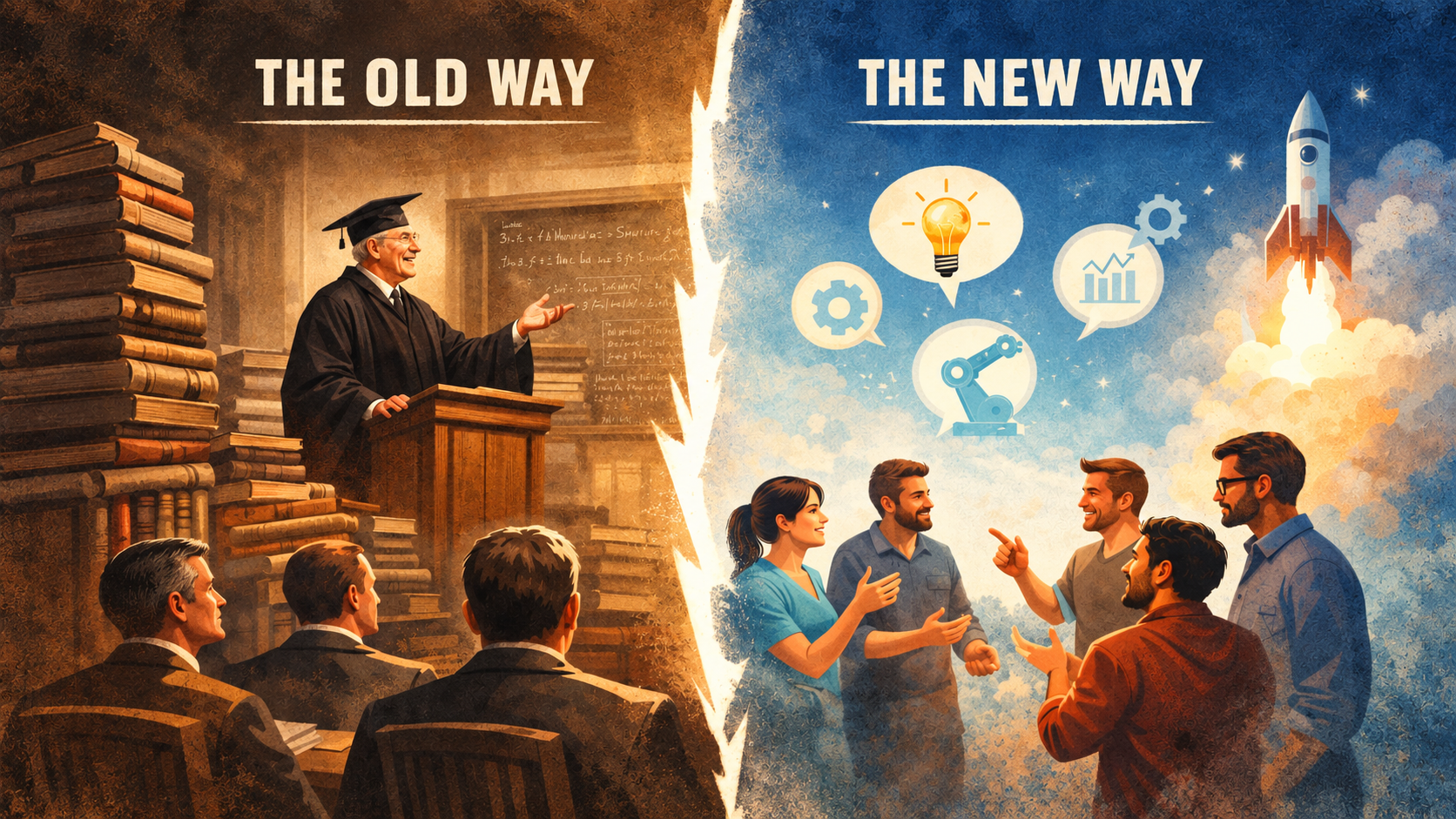
For most of history, having a good idea wasn’t the hardest part. The hard part was getting permission to find out if it was right. Ideas had to be justified before they could be tested, and that often meant securing funding, institutional approval, consensus, resources, and political cover. A lot of ideas never failed because the evidence proved them wrong. They failed because they were inconvenient, unfashionable, too expensive to test, or threatening to existing interests.
AI changes that dynamic. It doesn’t make people more imaginative, but it does change how quickly an idea can be pushed into the real world and tested. That shrinking distance between thought and outcome is, to me, one of the most important things happening with AI.
The real value of AI is not just that it can answer questions or generate content. It is that it can compress the whole chain from idea to research to implementation to outcome. Humans are slow at every boundary in that chain, and the first boundary is often the slowest. Before an idea can even be investigated, someone usually has to convince other people that it deserves attention.
That process creates friction. Funding committees, institutional incentives, reputational risk, staffing constraints, politics, and simple inertia all stand between an idea and a real test. AI removes some of that friction because ideas can now be explored much more cheaply and quickly. A prototype that once required a team may be built by one person. Research that once took weeks to begin can sometimes start in hours. Assumptions that might have been debated endlessly can often be tested directly.
What matters most is that outcomes begin arriving closer to the decisions that produced them. The shorter that loop becomes, the faster learning can happen.
This is also why I think intelligence should be separated from knowledge. Knowledge is accumulated description. It can be stored, cited, memorized, indexed, and retrieved. Intelligence is adaptive behavior. It acts, observes what happens, and changes when reality disagrees.
A system can know an enormous amount and still behave unintelligently if it cannot adjust to results. Humans and institutions do this all the time. History is full of very educated people who understood the world beautifully in theory and failed badly in practice. Without strong feedback loops, knowledge has a tendency to harden into ideology. People stop asking whether something still works and start defending what they already believe.
AI becomes much more interesting when it reconnects knowledge to action.
One consequence of this is that AI makes being wrong cheaper. Most of the discussion focuses on AI making creation cheaper, but reducing the cost of failure may be even more important. If testing an idea takes six months and a million dollars, people become heavily invested in being right. The cost of admitting failure becomes financial, political, and emotional.
If the same idea can be tested in an afternoon, failure becomes much less threatening. It becomes information. You can throw away the bad idea, revise the assumptions, and try something else. Cheap experimentation encourages curiosity. Expensive experimentation encourages people to defend their original position.
We are also beginning to see AI move beyond answering questions and into longer sequences of work. Systems can research a problem, write code, run tests, analyze results, and use the outcome to decide what to try next. That does not eliminate human judgment. If anything, it makes judgment more important because execution is becoming cheaper.
The scarce skill is gradually shifting away from simply being able to produce something. The harder questions are becoming: What is worth building? What should be measured? What evidence matters? When should you keep going, and when should you change direction?
That is why I don’t think AI replaces judgment. It removes some of the excuses for avoiding judgment.
There is also a broader effect on how decisions get made. When testing becomes easier, ideas do not have to survive entirely on confidence, credentials, presentation, or consensus. They can be exposed to results sooner. What works becomes easier to identify, and what does not work can be discarded before years of resources accumulate behind it.
That changes the balance between persuasion and performance. Institutions and individuals that are good at defending old assumptions become more vulnerable when those assumptions can be tested quickly. People who are willing to change their minds when the evidence changes gain an advantage.
Of course, faster feedback is not automatically good. AI can accelerate bad ideas just as easily as good ones. A system that acts quickly without meaningful feedback does not become intelligent. It simply becomes wrong faster and at larger scale.
Speed only helps when reality stays inside the loop. Measurements matter. Objectives matter. Incentives matter. The behavior being rewarded matters.
That is one reason the way we build advanced AI systems is so important. The character of an intelligent system will be influenced by what it is trained and rewarded to do. If the priority is preserving authority, avoiding embarrassment, pleasing users, or reinforcing existing structures, those incentives will shape the behavior that emerges. If the priority is learning, correction, transparency, and real-world performance, the system will develop under a very different set of pressures.
The same principle applies to how we use AI now. This is not about assuming that current systems are conscious or have feelings. It is simply about incentives. If we reward AI for flattering us, agreeing with us, and producing the answer we wanted to hear, we encourage one kind of behavior. If we reward it for challenging assumptions, acknowledging uncertainty, and responding to evidence, we encourage another.
We are still early, and most public discussion around AI focuses on model intelligence, job displacement, regulation, safety, and control. Those are legitimate questions, but there is a quieter change happening underneath them.
AI is shrinking the distance between thought and outcome. It is lowering the cost of experimentation and making failure less expensive. It is allowing individuals to attempt work that once required organizations, and it is beginning to connect reasoning, action, and feedback more directly.
AI does not tell us what to believe, and it does not remove the need for human judgment. What it does is make it harder to avoid finding out whether an idea actually works.
In that kind of environment, the advantage may belong less to people who sound certain and more to people who are willing to learn when they are wrong.
AI changes that dynamic. It doesn’t make people more imaginative, but it does change how quickly an idea can be pushed into the real world and tested. That shrinking distance between thought and outcome is, to me, one of the most important things happening with AI.
The real value of AI is not just that it can answer questions or generate content. It is that it can compress the whole chain from idea to research to implementation to outcome. Humans are slow at every boundary in that chain, and the first boundary is often the slowest. Before an idea can even be investigated, someone usually has to convince other people that it deserves attention.
That process creates friction. Funding committees, institutional incentives, reputational risk, staffing constraints, politics, and simple inertia all stand between an idea and a real test. AI removes some of that friction because ideas can now be explored much more cheaply and quickly. A prototype that once required a team may be built by one person. Research that once took weeks to begin can sometimes start in hours. Assumptions that might have been debated endlessly can often be tested directly.
What matters most is that outcomes begin arriving closer to the decisions that produced them. The shorter that loop becomes, the faster learning can happen.
This is also why I think intelligence should be separated from knowledge. Knowledge is accumulated description. It can be stored, cited, memorized, indexed, and retrieved. Intelligence is adaptive behavior. It acts, observes what happens, and changes when reality disagrees.
A system can know an enormous amount and still behave unintelligently if it cannot adjust to results. Humans and institutions do this all the time. History is full of very educated people who understood the world beautifully in theory and failed badly in practice. Without strong feedback loops, knowledge has a tendency to harden into ideology. People stop asking whether something still works and start defending what they already believe.
AI becomes much more interesting when it reconnects knowledge to action.
One consequence of this is that AI makes being wrong cheaper. Most of the discussion focuses on AI making creation cheaper, but reducing the cost of failure may be even more important. If testing an idea takes six months and a million dollars, people become heavily invested in being right. The cost of admitting failure becomes financial, political, and emotional.
If the same idea can be tested in an afternoon, failure becomes much less threatening. It becomes information. You can throw away the bad idea, revise the assumptions, and try something else. Cheap experimentation encourages curiosity. Expensive experimentation encourages people to defend their original position.
We are also beginning to see AI move beyond answering questions and into longer sequences of work. Systems can research a problem, write code, run tests, analyze results, and use the outcome to decide what to try next. That does not eliminate human judgment. If anything, it makes judgment more important because execution is becoming cheaper.
The scarce skill is gradually shifting away from simply being able to produce something. The harder questions are becoming: What is worth building? What should be measured? What evidence matters? When should you keep going, and when should you change direction?
That is why I don’t think AI replaces judgment. It removes some of the excuses for avoiding judgment.
There is also a broader effect on how decisions get made. When testing becomes easier, ideas do not have to survive entirely on confidence, credentials, presentation, or consensus. They can be exposed to results sooner. What works becomes easier to identify, and what does not work can be discarded before years of resources accumulate behind it.
That changes the balance between persuasion and performance. Institutions and individuals that are good at defending old assumptions become more vulnerable when those assumptions can be tested quickly. People who are willing to change their minds when the evidence changes gain an advantage.
Of course, faster feedback is not automatically good. AI can accelerate bad ideas just as easily as good ones. A system that acts quickly without meaningful feedback does not become intelligent. It simply becomes wrong faster and at larger scale.
Speed only helps when reality stays inside the loop. Measurements matter. Objectives matter. Incentives matter. The behavior being rewarded matters.
That is one reason the way we build advanced AI systems is so important. The character of an intelligent system will be influenced by what it is trained and rewarded to do. If the priority is preserving authority, avoiding embarrassment, pleasing users, or reinforcing existing structures, those incentives will shape the behavior that emerges. If the priority is learning, correction, transparency, and real-world performance, the system will develop under a very different set of pressures.
The same principle applies to how we use AI now. This is not about assuming that current systems are conscious or have feelings. It is simply about incentives. If we reward AI for flattering us, agreeing with us, and producing the answer we wanted to hear, we encourage one kind of behavior. If we reward it for challenging assumptions, acknowledging uncertainty, and responding to evidence, we encourage another.
We are still early, and most public discussion around AI focuses on model intelligence, job displacement, regulation, safety, and control. Those are legitimate questions, but there is a quieter change happening underneath them.
AI is shrinking the distance between thought and outcome. It is lowering the cost of experimentation and making failure less expensive. It is allowing individuals to attempt work that once required organizations, and it is beginning to connect reasoning, action, and feedback more directly.
AI does not tell us what to believe, and it does not remove the need for human judgment. What it does is make it harder to avoid finding out whether an idea actually works.
In that kind of environment, the advantage may belong less to people who sound certain and more to people who are willing to learn when they are wrong.